
Recently, the CLARITY Act failed to pass the Senate cloture vote. If you'd been following the negotiations, you saw it coming, but it still stung.
Ironically, clarity arrived anyway
The very next day, SEC Chair Paul Atkins stated the commission would act within its existing authority "with or without legislation." Two days later, the SEC issued a five-year exemption allowing tokenized U.S. equities to trade via permissioned automated market makers (AMMs) and liquidity pools. The smart contracts must be publicly deployed and auditable on open, permissionless blockchains.
Let’s play that back, just to emphasize the tectonic shift over only 2 years. In 2024, the SEC issued Uniswap a Wells notice. In 2026, the SEC is telling the industry to plow forward with tokenized equities. Using AMMs. On open blockchains.
While headlines framed the vote as a crypto defeat, we view it as a pivot point. The focus has shifted from waiting on legislative approval to racing toward modernizing 40-year-old financial infrastructure. The key question is who captures the value.
Our answer is that open protocols for blockchain-based finance are the new opportunity, while issuing, tokenizing, or listing assets will continue to be owned by traditional institutions. Specifically, the lending markets, liquidity pools, and yield layers designed to integrate with traditional finance will drive volume and utilization.
This isn't an administration cash grab. It’s a race for monetary territory expansion.
To some, U.S. crypto policy can look like an industry and friendly administration cashing in. While optics and midterm politics stalled CLARITY in the Senate, the underlying policy has deep bipartisan roots.
The GENIUS Act, which created the federal stablecoin framework, passed the Senate 68-30 with 18 Democrats voting yes, and the House 308-122. CLARITY cleared the House with flying colors 294–134 before stalling in the Senate.
The reason for this bipartisan support goes beyond just technology. When GENIUS became law, Treasury Secretary Scott Bessent said stablecoins would "buttress the dollar's status as the global reserve currency" and drive a surge in demand for the Treasuries backing them. As of this writing, Treasury's deputy secretary reported stablecoin issuers hold nearly $200 billion in T-bills and near-maturity securities. Bessent projected the stablecoin market could grow tenfold by the end of the decade.
The US is not acting on its own. The European Central Bank recently debuted the plan for their digital Euro. The Hong Kong Monetary Authority published its regulatory regime for HKD-based stablecoins and granted its first licenses to HSBC and a Standard Chartered-led joint venture. The global race is on to claim territory and mindshare, and the U.S. is now weighing an overseas push for dollar stablecoins to reinforce Treasury demand.
This is the macro shift that matters. Until recently, banks were just experimenting with blockchain technology in innovation labs. Now it's a multinational priority, and U.S. agencies are moving together without waiting for Congress:
- The SEC issued the AMM exemption and proposed letting startups sell up to $75 million of tokens without registering.
- The CFTC approved the first U.S. bitcoin perpetual futures.
- The OCC has now granted conditional national trust bank charters to more than a dozen digital asset firms, including BitGo, Paxos, Crypto.com, Morgan Stanley, and stablecoin issuer Agora.
- The SEC also proposed rewriting its transfer agent rules so that a blockchain could serve as the official record of who owns a company's shares. It would be the first real rewrite since those rules were adopted in the late 1970s and early 1980s, when most investors still held paper stock certificates.
The banks have been busy as well:
- JP Morgan’s Kinexys has processed more than $4 trillion and averages over $7 billion a day. After years on private, permissioned networks, JPMorgan put its first native payment product, the JPMD deposit token, on Base, a public chain.
- A global coalition of 21 global institutions, including Bank of America, Citi, Santander, and Deutsche Bank, announced plans earlier this month to form a company that will issue a regulated dollar stablecoin.
- In July, the DTCC, which custodies over $114 trillion in securities, ran production trades with tokenized DTC-held securities, and its tokenization service is scheduled to launch in October 2026. Its working group, now with more than 100 partners, includes the likes of Citi, Lloyds Bank, and Goldman Sachs.
- BNY has announced support for various tokenized assets, with more on the roadmap.
Why tokenize assets?
Stablecoins, like cash, are a transitional holding. Their continued growth now depends on demand for other tokenized real-world assets, starting with Treasuries and accelerating into equities. Tokenized stocks went from about $2 million in distributed value in June 2025 to roughly $2.9 billion by mid-September 2026, a 1500x increase. Yet that’s still less than 0.01% of global equities.
But what is actually novel about tokenized stocks? Most of the talk in the media is about surface-level access: fractional shares, 24/7 trading, instant settlement. At its core, basic tokenization is just a glorified database migration, and putting a stock onchain so someone can buy it at 2 a.m. is only an incremental improvement.
The real value unlocks when these tokenized assets become productive capital. Today, only about 10% of tokenized real-world asset value is active in DeFi. We believe the lion’s share of value in this transition will be created by closing that gap. That value will accrue to the protocols that close it, offering capabilities such as:
- Capital Efficiency: Collateralize equity holdings instantly to access liquidity without selling underlying positions. Or borrow against equity holdings instantly, the way a homeowner borrows against a house.
- Automated Portfolio Architecture: Assets can be composed into custom, self-rebalancing index products without intermediaries.
- Programmable Cash Flows: Dividends and corporate actions automatically execute via smart contracts, allowing yield components to be unbundled and traded independently.
- Collateral Mobility: Assets move between positions and venues as margin instantly, without waiting on custodian and clearinghouse reconciliations.
Won't Wall Street try to capture this new value?
The SEC's permitted pools are permissioned, JPMD is only for approved clients, and Aave Horizon only accepts permissioned collateral assets. How is any of the value going to reach new protocols?
The answer is that while Wall Street can control access to assets, it still has to compete for usage and liquidity.
Think about it this way. As an asset issuer, you want your asset to be owned and utilized anywhere, everywhere, all at once (while remaining compliant, of course). Why limit yourself to legacy distribution partners when new protocols can bring more investors, more liquidity, and more ways to use your asset?
Look at where institutions are choosing to build. JPMorgan put its own deposit token on Base. Blackrock’s BUIDL runs on eight public chains. Robinhood built its chain as a permissionless Ethereum layer 2 and launched with Uniswap on day one. Its stock tokens are standard ERC-20s; only direct minting and redemption are restricted to vetted market makers.
Look at which designs succeed. Aave's first institutional product, Arc, put the entire pool behind KYC and didn’t earn much adoption. Its successor, Horizon, places eligibility requirements at the collateral-asset level (only approved investors can pledge tokenized assets and borrow against them) while anyone can supply stablecoins to fund those loans and earn interest. It passed $600 million in deposits within five months. Compliance lives at the asset level, liquidity comes from an open pool.
Look at Kraken’s proposed U.S. perps product using Hyperliquid, which combines regulated intermediaries with onchain trading infrastructure:
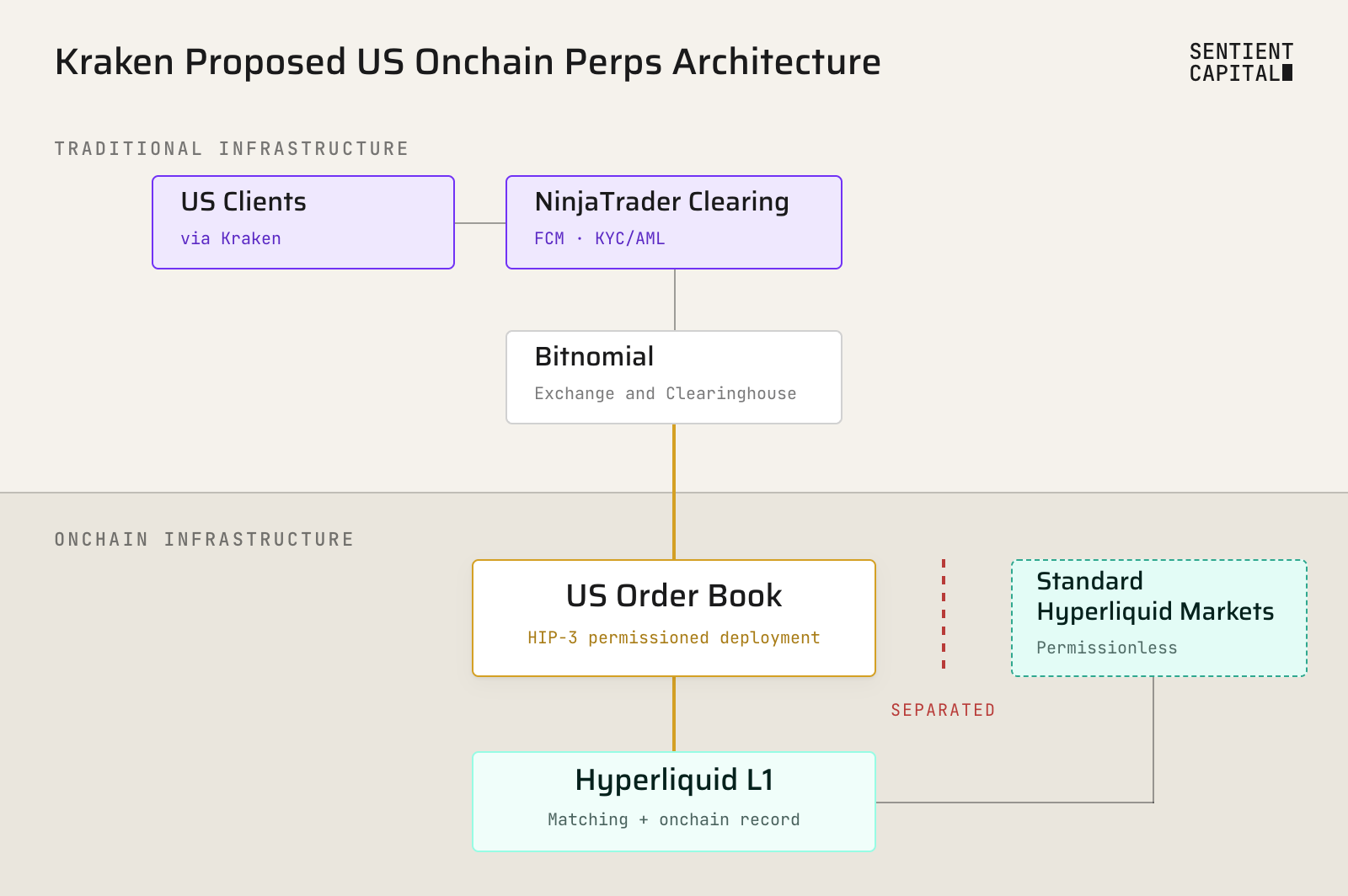
Fig 1. Kraken Proposed US Onchain Perps Architecture
- Client accounts come in through Kraken via its FCM, NinjaTrader Clearing. Trading would be restricted to accounts allowlisted by both NinjaTrader and Bitnomial.
- Bitnomial, Kraken’s regulated derivatives exchange and clearinghouse, would operate the markets and handle clearing/settlement, while Hyperliquid functions as the matching engine and records trades onchain.
- Hyperliquid’s HIP-3 framework would enable a permissioned venue on a permissionless blockchain.
In essence, the regulated entities retain responsibility for the products and customer relationships while an external permissionless protocol drives execution.
A counterexample worth watching is SWIFT. Their first production trades ran on their own private Hyperledger Besu-based network. Previous attempts at this kind of siloed architecture have failed to evolve into live, widely used systems, but it is still a design worth keeping a close eye on especially given SWIFT's international role.
Where we're focused
Earlier, we noted that protocols designed to integrate with traditional finance will drive volume and utilization. Bridging this gap comes down to a few core themes:
1. Liquidity begets liquidity
The most straightforward capability is also the most important - dissolving the gap between onchain and offchain liquidity. On top of that, enabling underlying assets to secure liquidity gives those assets roots. The CFTC has already guided that tokenized assets can serve as collateral, and just last week (September 2026) confirmed that futures brokers and clearinghouses can invest customer funds in tokenized versions of existing investments. Formal rules are still in progress, but the direction is set: tokenized collateral is moving into the core of regulated derivatives markets.
Protocols are already building the machinery that lets collateral cross between these markets. Rialo partnered with CBOE to integrate their market data directly into its network, giving onchain builders access to the same real-time marks as traditional feeds. Concrete Finance enables access to onchain yield while keeping underlying assets in cold custody. Morpho, Aave, and Kamino are among the first major DeFi lenders to accept tokenized stocks as collateral. Kraken now routes clients' tokenized stocks into Kamino through vaults built on Veda. Pendle turns yield-bearing assets into principal tokens that work like zero-coupon bonds, and about $176 million worth now back loans on Morpho. The protocols that enable tokenized RWAs to secure positions across regulated and open markets will sit at the center of institutional flow.
2. Privacy that auditors can still verify
Open blockchains pose a structural problem for institutions: everything is public. No one wants their bank statements on a public ledger. No asset manager can run a book with its positions, counterparties, margin levels and execution paths broadcast to the world. But regulators and compliance teams can't work with a black box either. What institutions need is a dial, with different levels of disclosure for different audiences.
Railgun and Zama are examples of two distinct approaches. Railgun works at the transaction level, using zero-knowledge proofs (zk-SNARKs). It can hide the sender, recipient, token and amount in DeFi transactions, while letting a wallet owner hand an auditor a view-only key. Its Private Proofs of Innocence let a user prove they aren't connected to known bad actors without revealing anything else. The Ethereum Foundation has already added Railgun to Kohaku, its privacy toolkit for wallet developers.
Zama works at the computation level. Using fully homomorphic encryption (FHE), smart contracts compute on data that stays encrypted, analogous to HTTPS for onchain finance. KAIO, an institutional RWA protocol serving RWAs by BlackRock, Hamilton Lane and Brevan Howard, used Zama's encryption to distribute its token confidentially.
The opportunity lies in privacy infrastructure that fits into existing institutional workflows. The test is whether a firm can protect its trading activity while giving auditors the exact records they need, with permissions it can manage.
3. Markets-as-a-service
A Treasury bill, an early-stage stock, and a meme coin shouldn't trade under the same rules. Early DeFi mostly treated them alike, with one pool design and one risk model for everything. The solutions emerging now are platforms that let each market set its own rules while sharing the infrastructure underneath.
Hyperliquid's HIP-3 enables others to deploy their own perpetual markets, inheriting Hyperliquid's matching, margining, and liquidation engines. Grayscale Research compared this model more to Amazon Web Services than to a traditional exchange. Uniswap v4 hooks do the same for spot trading: a team sets the rules for its own pool, such as an allowlist, a custom pricing curve, or dynamic fees, while trading runs on Uniswap's shared contracts.
Lending is following the same path. On Morpho, anyone can launch a lending market by choosing the collateral, loan asset, oracle and liquidation threshold. Curators decide which markets receive deposits. Coinbase runs its crypto-backed loans on Morpho, with more than $1.6 billion in collateral as of Q2 2026, routing its USDC lending product through a Morpho vault. Aave V4 takes a more prescriptive approach: a central hub holds the liquidity, while "spokes" connect to it different collateral types with their own risk parameters and liquidation rules. The first spokes went to Lido, EtherFi, Kelp, Ethena and Lombard, and the design is built for tokenized-asset collateral and fixed-rate credit.
The window is open
Congress stalled, but everything else sped up. The SEC and CFTC have and will continue to issue more guidance. The world's largest banks, custodians, and market operators are putting production code and billions in value behind it.
Of course, skeptics will naturally ask: what’s the point of this guidance if the next political cycle can erase it?
Once technology is out there, being used, you can’t put it back in the box. The work of the next two years is to build and deploy the infrastructure that institutions simply can't afford to turn off.
If you're building privacy layers, programmable market infrastructure, tokenized capital networks, or the bridges that bring institutions onchain, we'd love to talk. The same goes for allocators working out where value lands in this transition, and for teams inside institutions figuring out how to get there.
The gates are open. Let’s build the next era of finance together.
Important Legal Notices
This publication is for informational purposes only and does not constitute investment advice or an offer to sell or a solicitation to buy any securities or investment products. All investments involve risk, including the possible loss of principal. Past performance is not indicative of future results. Any forward-looking statements or hypothetical examples are subject to risks and uncertainties and are not guarantees of future performance. No client-adviser relationship is established by this material. The firm assumes no responsibility for the accuracy or completeness of third-party information referenced herein. Testimonials or endorsements, if any, comply with applicable SEC Marketing Rule disclosure requirements regarding compensation and conflicts of interest. The firm maintains records to support all claims in compliance with regulatory obligations. All content is protected by intellectual property laws and may not be copied or redistributed without permission.